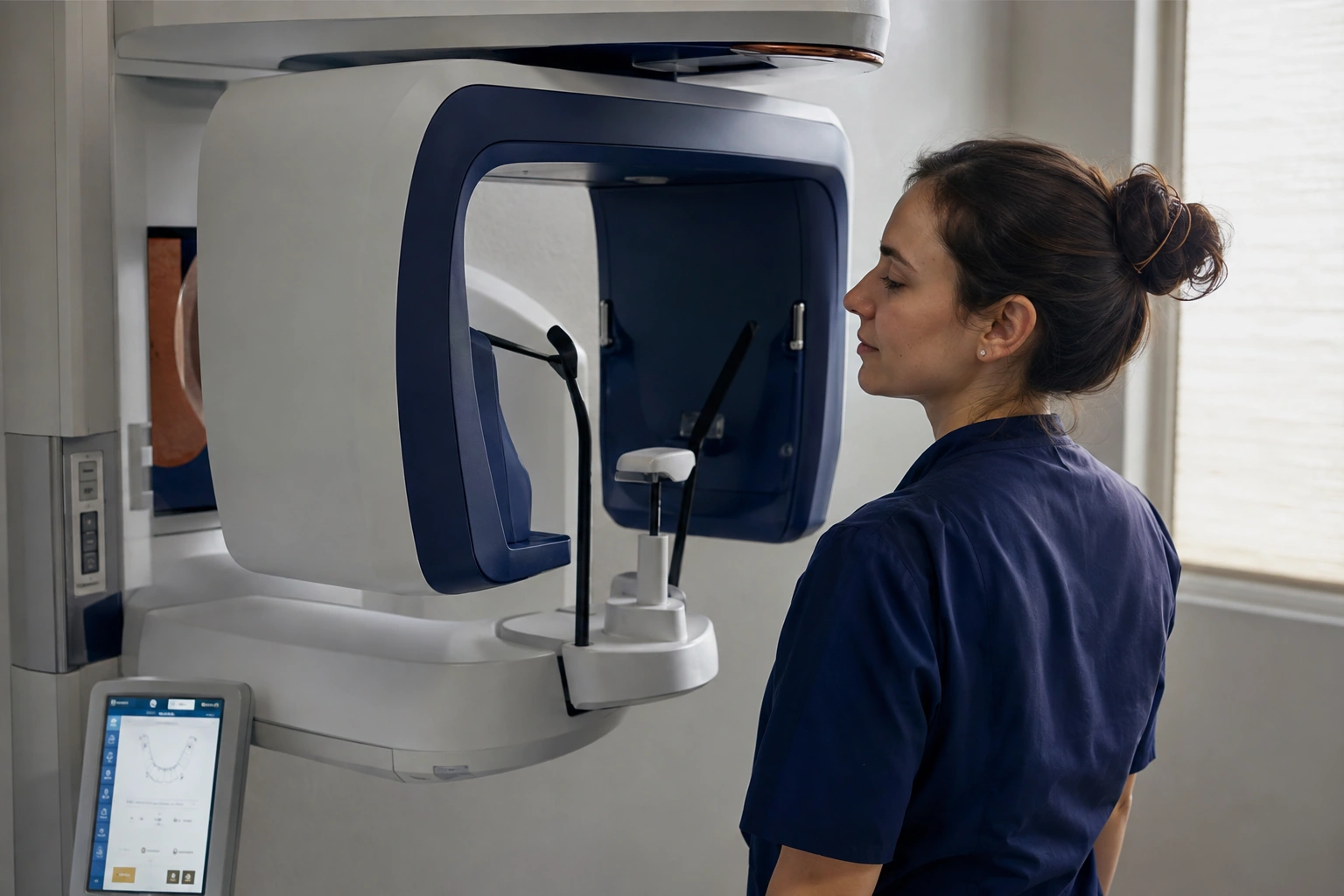
Dental imaging can help answer questions that an examination alone cannot. Cone-beam computed tomography, often called CBCT, provides three-dimensional information about teeth and the jaws. It is an additional diagnostic tool for selected situations, rather than a routine requirement for every dental visit.
How CBCT differs from a conventional dental X-ray
A CBCT system moves around the head and collects images that are reconstructed into a three-dimensional view. Conventional dental X-rays provide two-dimensional views. Your dentist considers which view is necessary for the question being investigated and whether existing images are sufficient.
When it may be discussed
A clinician may consider three-dimensional imaging for selected implant planning, complex tooth anatomy, impacted teeth or other questions involving the jaws. The decision should be specific to the examination and planned treatment. More detailed imaging is not automatically better for every person.
Benefits and radiation exposure
The FDA advises that dental CBCT be used when the needed clinical information cannot be obtained with other imaging options. CBCT generally uses more radiation than conventional dental X-rays, even though it may use less than some medical CT examinations. The relevant comparison is the particular test needed for your care.
Discuss why the scan is recommended, how it may change the plan and whether a lower-exposure option can answer the question. Tell the team about previous imaging and ask whether those records can be shared to avoid unnecessary repetition. Children require particular attention to the clinical need and exposure settings.
Questions about access and cost
Ask the practice whether imaging is performed in the office or arranged elsewhere, who will interpret it, what it costs and when the results will be discussed. An educational article about CBCT does not establish that a particular scanner is installed at Valley Ranch.
Make the image part of a conversation
Ask your dentist to explain the finding in ordinary language and connect it to the options being considered. Images support clinical judgment; they do not guarantee a diagnosis, eliminate treatment risk or replace a complete assessment. Bring questions about the recommendation before proceeding.
Originally published by Valley Ranch Family Dentistry. Editorial update: September 7, 2026. General educational information; your dentist can discuss how it applies to your own care.